Romans 12:3 ESV For by the grace given to me I say to everyone among you not to think of himself more highly than he ought to think, but to think with sober judgment, each according to the measure of faith that God has assigned.
As we move forward training in our concealed carry skills, I believe one of the important questions we need to ask and honest answer are: What is my current skill level and where to I need improvement? Following the advice of Paul in his letter to the romans it is important to use an true self reflection to assess yourself.
It can difficult for some people to be honest themselves and their capabilities. They believe they are amazing with the pistol yet when tested perform below average, only to get frustrated and make excuses rather focusing on how they could improve. Don’t ignore problem areas, or dwell on a bruised ego.
Another issue you should guard against is dwelling on the negative parts of your skill or performance. Being Eeyore from Winnie the Pool solves no problems either. Identify the issue, and make a plan to fix it or at least mitigate it until it can be fixed or is no longer an issue.
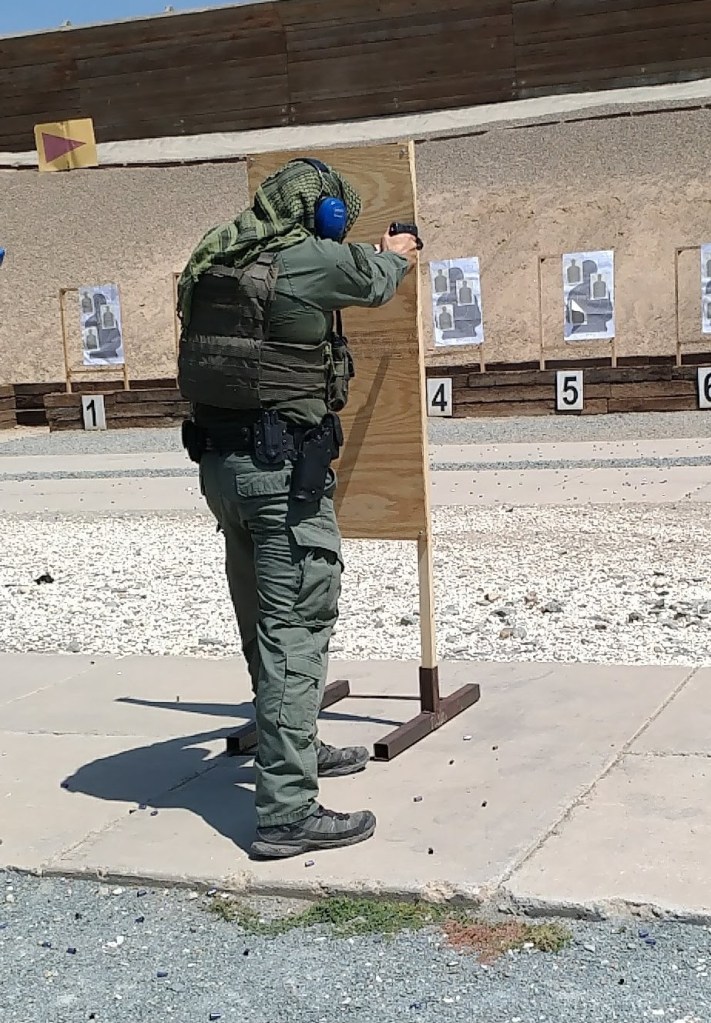
When training in combat style shoot there should be focus on the balance of speed and accuracy. We need to think about tactics and more than punching tiny groups on the flat range. We are likely training for one of three things: stopping an immediate life threat right in our personal space, breaking contact and getting out of there, or closing the distance to a threat which is causing immediate life threats to you or other innocent people.
It is tactical sound to use cover and concealment as much as possible, even if the only cover is our muzzle. Cover is an obstacle or barrier which can stop a bullet; whereas concealment is something which blocks you from the threats sight. While this is a topic best addressed in another article, it is worth considering in our shooting training. As we should work this into our training especially once we have a baseline.
There needs to be a set standard. This standard will give you a goal to strive for, to maintain, and to improve upon. How do you pick or set a standard though? A law enforcement qualification course of fire is a starting point. Most will cover many different shooting situations and give you a baseline.
Some things to consider:
- You should practice from each way you carry, for example open and concealed.
- Practice shoot/no shoot scenarios.
- Know how to take a contact shot. And why it is important.
- Practice one handed shooting (both left and right side). Practice reloading one handed as well.
- You should have drills covering shoot and move, moving to cover, and multiple targets.
- Short range of 1 1/2 and 3 yards. Intermediate of 7 and 15 yards. And long range of 25 and 50 (longer then better).
- Practice low light shooting, most gun fights are at night.
- Most shootings are at a close range.
- Don’t discount either long range or day time situations though. With the increase in violence and attacks on public spaces, Elisjsha Dicken saved lives with his actions I have no doubt.
If my memory serves me, and it may not, here is what the border patrol qualification was when I was in. According to the internet the qualification has changed to a 50 round course of fire. It is 72 rounds and the times per stage I do not remember.
- From the holster at the 1 1/2 yard line. One hand, bent elbow shooting: First string 1 round, Second string 2 rounds, and third string 3 rounds.
- From the holster at the 3 yard line. Two hand, point shooting. First string 1 round, second string 2 rounds,and third string 3 rounds.
- From the holster at the 7 yard line. First buzzer draw and fire 2 rounds two handed, transition to right hand only and fire 1 additional round. At second buzzer ceace fire and remain at high search. At the third buzzer fire 3 rounds right hand only. Repeat drill but switching to left hand only on the one handed portions.
- From the holster at the 7 yard line. At the buzzer draw and fire 1 round. At the second buzzer cease fire and remain at high search. At the third buzzer fire one additional round from high search. Repeat with 2 and 2 rounds, then 3 and 3 rounds.
- From the holster at the 15 yard line draw fire 1 round. Repeat with 2, 3, and 4 round strings of fire.
- From the holster at the 15 yard line with one round in the chamber and one round in the magazine. Draw and fire 2 rounds from standing. Perform an emergency reload while transitioning to the kneeling, higher 2 additional rounds from the kneeling. Remain at high ready for the next stage.
- From the kneeling high ready at the 15 yard line. Fire 1 round and return to the high ready. Repeat with 2, then 3 rounds.
- From the holster at the 25 yard line. Draw and move to cover, utilizing the right side of the barricade. Fire 4 rounds standing, transition to kneeling and fire 4 additional rounds. Repeat from the left side of the barricade.
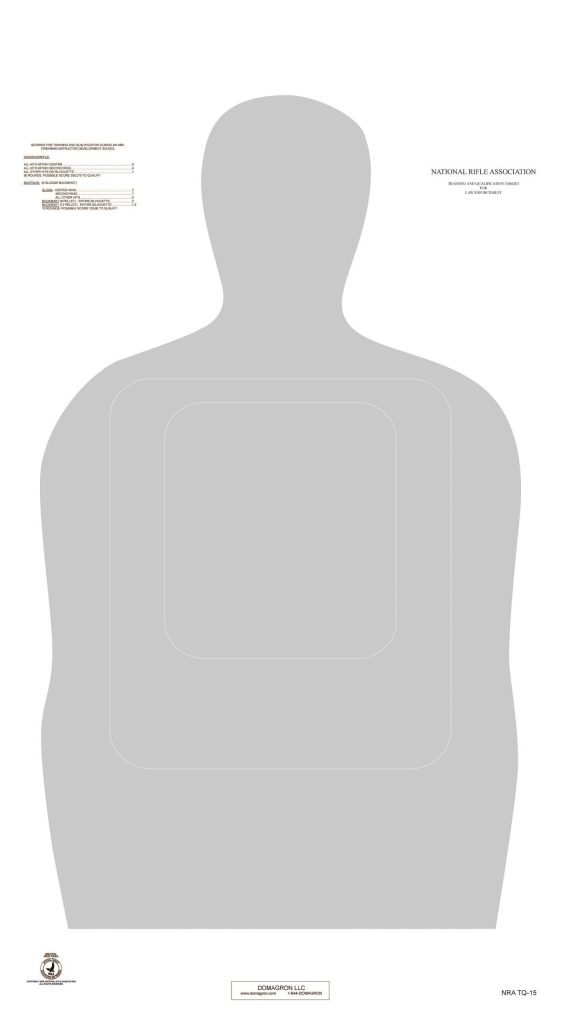
This qualification was shot using an NRA TQ15 target.
There are limitations to any qualification, after all it has to be fairly quick and easy to administer. They function as a baseline and NOT an all inclusive training package.
- Be aware that a law enforcement qualification was designed to shot with a gun belt and not from concealed.
- Movement, cover, and concealment are not emphasized or giving only lip service due to practicality for multiple stages needing to be done rapidly.
- Multiple targets aren’t typically part of a qualification.
- Long range shooting isn’t usually included. And no, 25 yards is not long range.
I would consider picking a qualification of some type and using it as a trackable metric in your own personal training. Test yourself periodically and keep notes. This will allow you to see areas of strengths and weakness, which will give you an idea of where to maintain and improve as you plan your training.
For me personally, I need to work on my one handed firing drills.
-Joe
Remember to consult your attorney for legal advice, and not some guy on the internet.
 Outpost 95