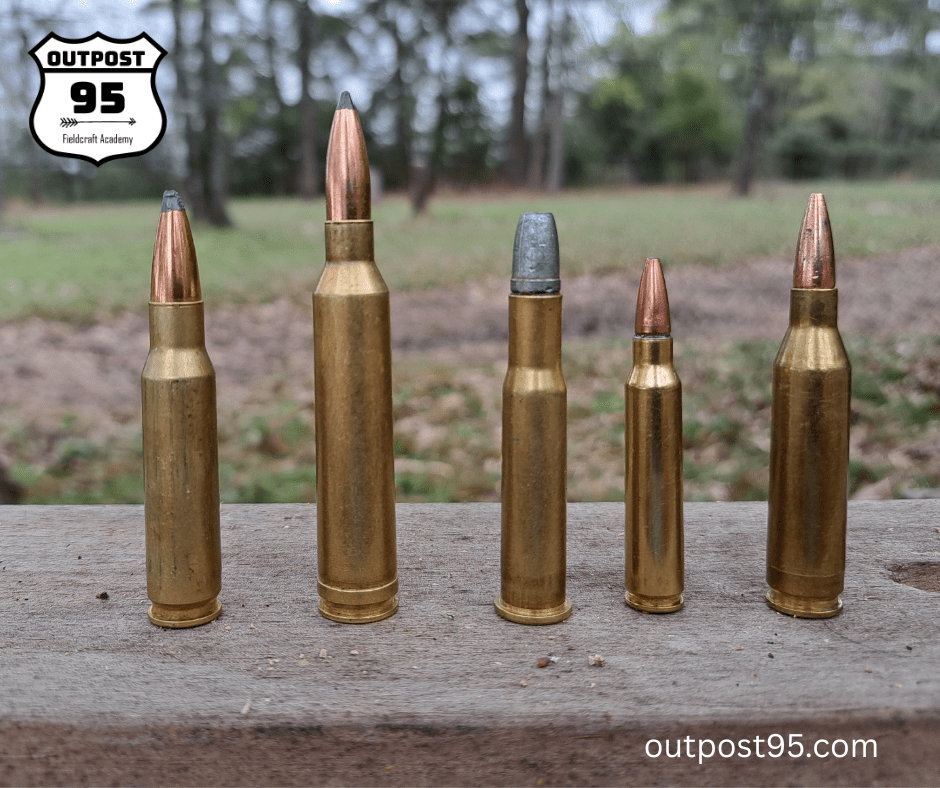
Have you ever wondered why people are arguing over what is a better deer cartridge a 6.5 Creedmoor, 7mm-08, 308, 270, 30-06, 35 Whelen, 45-70, etc. etc.? It’s like arguing over Chevy, Ford, Dodge, Toyota, etc. for half ton trucks. It doesn’t matter, at all. There are minor tradeoffs but if you put an appropriately designed bullet into a the right part of a deer all of them work just fine.
Now first off, I haven’t used everything under the sun as far as cartridge are concerned, but I have used or seen in use a decent cross section from big and slow to small and fast. I have used guns as a hunter and on the farm to dispatch gun vermin and livestock. I have been to war as a Corpsman and while my job wasn’t primarily that of a trigger puller. I put my eyes or hands on all the wounded or dead, both ours or theirs. Same when I was in the Border Patrol, I was also an EMT, so the few that got shot, I got an up close and personnel look. I reload and shoot as much as I can. I have taught firearms (and other stuff). That is where I draw my opinions from.
I am not a ballistician. I am not a competition shooter where small differences in a cartridge might give you the winning edge. The only living thing I have shot at past 250 yards is prairie dogs or whistle pigs. Not to say I haven’t willing to shoot further, but rather the need hasn’t come up yet. One part of hunting I enjoy, is seeing how close I can get.
Currently I have no public service role, and don’t see a good reason to go back into that line of work, its someone else’s turn. I like to hunt, shoot, and am a prepared citizen. I find the intricacies of ballistics and cartridge interesting and probably study them more than I should. Ultimately though it is results that matter and that is far more interesting to me.
When I was in the Navy and Border Patrol, I didn’t get to pick what gun or cartridge they gave us to use. For large parts of my career, I would have liked to pick what I was using. Here is what I figured out though, it’s the Indian not the Arrow. Whatever tool they put in your hands wasn’t the best choice, but it was good enough. Frankly who is to say I would have made a “better” choice if I could have chosen myself. Ultimately the thing that mattered the most was if you were competent with your tools.
Bottom line up front, it doesn’t really matter all that much which cartridge you pick. There is so much overlap that many cartridges will essentially all do the same thing. This is why the new shooter becomes confused. He or she is told to use this thing or that thing. Everyone has some opinion or story about how each choice is the best or the worst. Some of it is truth and some opinion. Mostly the person describing their choice is so emotionally invested that they become defensive if someone else doesn’t also choose that same thing. That is a person who is insecure about their decision and frankly if they aren’t secure in their position, why would you take their word as gospel?
The first thing I will tell you is that hits matter. When picking a cartridge, I would make sure it is one that you will practice with. Meaning it must be available to buy at the store. If Walmart, Tractor Supply, the gas station, and the feed store all have it that is a good sign.
Same with reloading components are powders in the burn rate ranges you need available? Or primers? How about bullets, there are more .30 caliber bullets available than .25 caliber bullets. Do you want cheap FMJ bullets to practice with in volume? If so the 22 or 30 calibers are good choices. How about cast or plated bullets? If you are buying instead of making them? They are available for purchase in 30, 44, and 45 calibers seem like the options.
Once you discover if it is available, you need to see if it is cheap to shoot? In several places across the country Hornady has an American whitetail line that put a box of twenty into a comparable price range whether it was a 243, 6.5, 30-06, or other common deer cartridges for $30 a box. Versus the 45-70 or anything by Weatherby which is double in price. Just make sure the cartridge you pick is in your price range to the point you don’t cry if you shoot an extra box in a training session.
Performance, here is where opinion and emotions come out. For most applications the construction of the bullet is far more important than diameter. It needs to be matched to launch velocity, impact velocity, and the target’s make up and size. It sounds complicated, but the thing is, if the ingredients are properly applied than the recipe turns out, even if it looks different than the option next to it. Most major ammunition manufactures have a vested interest in making a product that performs. So if they say it’s designed for deer it should work well on deer. Just do some research before you trust it on something bigger like a once in a lifetime elk trip.
The bullet must go where it is supposed to, meaning is it accurate enough. Secondly it must be stout enough to penetrate deep enough to hit something vital. What this means in the real world is, a fast-expanding bullet for small vermin might break up too quickly when shot into the shoulder of a whitetail deer.
There are caveats to this though. For example, a bullet that is frangible, or breaks up rapidly, out of a fast cartridge will not be as frangible out of a slower cartridge. In practice a .300 Winchester Magnum shooting a 125-grain varmint bullet at 3400 fps will break the bullet up on impact, while the same bullet out of a .300 Blackout at 2000 fps might be a good choice for a deer. As the lower impact velocity keeps and the bullet together while still allowing for expansion.
Which brings us to what we want a bullet to do. The bullet must disrupt enough tissue to cause a disruption in the central nervous system, the vascular system, or break enough joints and allow you to place another shot into the first two areas. A bullet through the brain or heart itself is almost always enough to incapacitate. I have seen far too many examples of bullets though the lungs that don’t expand where the game can get fair enough away, that it is not recovered.
We have all heard of cases of elephants getting killed with a 22 LR. I know in controlled settings butchers have killed untold scores of beef with it. This is in a controlled setting and under perfect conditions, outside of perfection it fails. I don’t know anyone in the wild who would grab a 22LR purposely to kill a wild beef or elephant, and anyone making that argument isn’t smart enough to think the problem through.
Muzzle velocity is interesting. If you are shooting long range or in the wind you will appreciate speed. I hunt close though and since my shooting is limited to a couple of hundred yards I like a 2,400 – 2,800 feet per second fps. As the caliber goes down, I like the speed to go up. If I lived in the prairie of South Dakota, I would find this set up too slow.
There are two competing schools of thought on power. One is simply to shoot a small very accurate rifle (223, 243, 6.5, etc.) for everything. They wait for a perfect shot and hit the brain or neck. This works especially well in a blind, deer box, or set up in clear cuts. They know their limitations and the slight caliber is completely adequate without the cost or blast. It requires discipline and skill to never miss and not take a marginal shot. It is a poor choice for self-defense applications where speed is more important than perfection. It is a bad idea to drive hunts where the game is running, or if less than perfection is reached on your end. It is great when you have time to evaluate and make a perfect shot. As a meat hunter I appreciate it.
Another school of thought is to use a little more cartridge. Targeting the heart and lungs as well, enough to break a shoulder a shoulder if need be. Having enough mass and/or speed just in case you push the shot into the edges of the vital zone. This would help compensate for a marginal shot. This usually is a slightly larger cartridge, more recoil, cost, and noise. More potential loss of meat. More options to secure game. As a realist I want a cartridge/bullet combination that will allow me to take game with whatever appropriate target area I am presented.
I understand that I have used a lot of generalizations. Maybe that is the clue, it generally is not that important which cartridge you pick because there is so much overlap. I also understand that I am advocating more for you to practice, rather than for you to pick the absolute best tool for one very specific scenario. This is because skill matters more than the tools.
Pick whatever you want out of the normal range of options, using this basic guild: if you mostly shooting small stuff then the smaller diameter of bullet is probably “better”. If you are mostly shooting larger/tougher stuff, I would pick a larger diameter bullet. The further away you expect something to be standing when the shot is made, the faster I would have the bullet travel. If the cartridge has been around for fifty years and there are still several options on the store shelfs than it’ll probably be around for a lot longer. If nowhere in town carries it, I wouldn’t buy it unless you know how to make your own, want something unique, or have a specific niche use case.
Below is a list of some general ideas, it isn’t all inclusive but if I haven’t said your pet cartridge then you don’t need my help picking out one.
Plinking/Training/Small Game
- 22 LR
- 22 WMR
- 17 HMR
- 223 Remington / 5.56 NATO
Predators
- .223 Remington / 22-250 Remington
- 243 Winchester
- 25-06 Remington
- 6.5 Creedmoor / 260 Remington
Medium Game (Deer, Hogs, Smaller Bears, Caribou)
- The 22, 243/6mm, and 25 centerfires if you are aware of bullet construction and limit your ranges to the performance of the speed.
- 6.5 Creedmoor and 260 Remington
- 270 Winchester
- 7mm-08 / 280 Remington
- 7mm Remington Magnum / 7mm PRC
- 30-30 / 308 / 30-06 / 300 Magnum
- 35 Whelen
- 45/70
Large Game (Elk, Bigger Bears, Moose)
- 270 Winchester
- 7mm Magnums / 7mm PRC
- 308 / 30-06 / 300 Magnum
- 338
- 35 Whelen
- 375
- 45/70
All of this applies to general hunting and shooting use most of us do day to day. I Also mentioned being a prepared citizen. In that world logistics matter more than anything else. I would look at 22LR, 223/5.56, 308/7.62×51, 9mm, and 12 gauge. Plus one rifle in whatever the locals hunt with that isn’t a current military. In this sense better doesn’t matter, having ammunition does.
Ultimate don’t spend too much time picking the perfect choice, find something you like and get out there and shoot. Shoot so much you wear it out, and spin a new barrel on. Then it won’t matter if the choice you made is best, because your skill will make up for it.
Happy shooting. And let me know in the comments what you use.
-Joseph
 Outpost 95