Yesterday we talked about the OODA Loop process for decision making and responding to issues. In that post I mentioned threshold decisions being used to help during the “Decide” portion of the Observe, Orient, Decide, and Act (OODA) Loop.
Sometime in the late 2000s, 2008 I believe, the Marine Corps introduced the Combat Hunter program. This was after I left the military and I don’t didn’t get to qitness firsthand its effect when applied to the real world. But with Camp Pendleton being down the street we had some guys on our team) Border Patrol) who got to attend the course.
I did get to attend numerous training courses on the law enforcement equivalent. Which focused on situational awareness and there was heavily emphasis on criminal and narcotics interdiction. As the Combat Hunter Course had a veteran detective design and teach the behavior profiling part I would guess we had a lot of carry over.
Most guys liked it and once put into practice it proved highly effective. An interesting point, after these classes usually at least one student would go home to notice a cheating spouse and get a divorce. Behavior profiling works.
The training focused heavily upon identifying the behavior queues to look for. Which are based heavily on the physiological and psychological responses a person goes through when they are doing something they know is wrong. Responses that are natural for the body and something they can’t control. And best of all they are universal and not tied to the culture a person is from.
It was a scientific approach to what veteran law enforcement and investigators took decades to develop, often called gut instinct or a Spidey senses, about a situation or person. A rather interesting topic we’ll cover more in upcoming posts.
On of the important points this situational awareness training hammered home was threshold decisions. If you notice enough queues or enough triggers have been tripped, then you must take some action. Not attempting to explain everything you noticed away or look for an excuse to not act what you saw. Unfortunately, most people choose not to act when something is noticed and that is how most issues are missed until it is too late. Forcing you to act prevents helps prevent unnecessary delay.
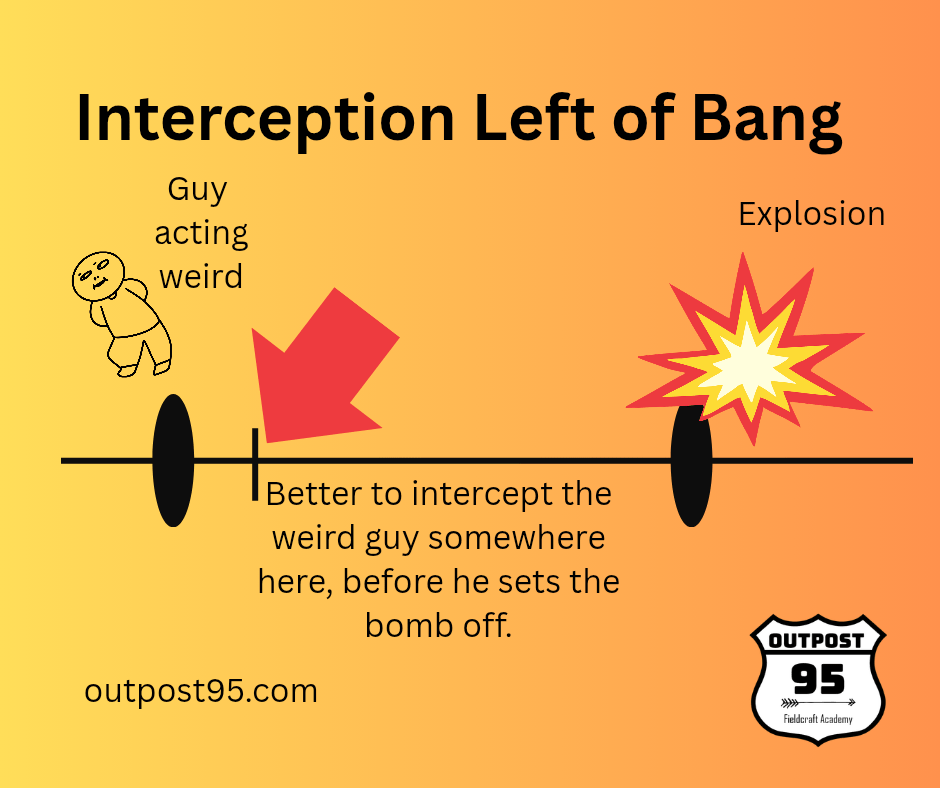
The threshold decision is to stop an bomber “left of bang” in the Marine Corps model. On a timeline read from left to right, left would come first and right later. So, if you are “left of bang” you are prior to the explosion of the IED (bomb).
How many queues before action? Three minor queues were usually the standard. If you notice three things then you need to do something. Even if it’s simply talking to the person, close monitoring, hogging tying them and throwing them in the back of your truck, or neutralizing the terrorist. It all depends on the situation and the circumstances.
The reason for multiple minor queues needing to exist is anyone could innocently give off a single behavior that could be mistaken for a queue, but when a cluster happens and is obvious enough to be observed, then there is reason the person is behaving this way.
All of this isn’t to say you don’t have to wait for three, rather you don’t want to wait for more. If one or two egregious things are noticed, then act immediately upon that information. Like a person with a bomb strapped to their chest, a man snatching a child, or coyote with your chicken in its mouth.
Don’t wait too long to act, address the problem before it gets worse. Remember OODA Loop, the quicker you can make it through the process the better you will have a favorable outcome. By using the threshold decision model, you can help to decide if the situation or person is worth further action and if there aren’t enough queues then you can move on to solve the next problem.
Be safe out there.
-Joseph
 Outpost 95