A new hunter told me he couldn’t go out in the woods alone because he would get lost. He had never really spent anytime in forest with the limited exception of a hiking on established trails, having grown up in town and wandering around the woods to explore was really a foreign concept to him.
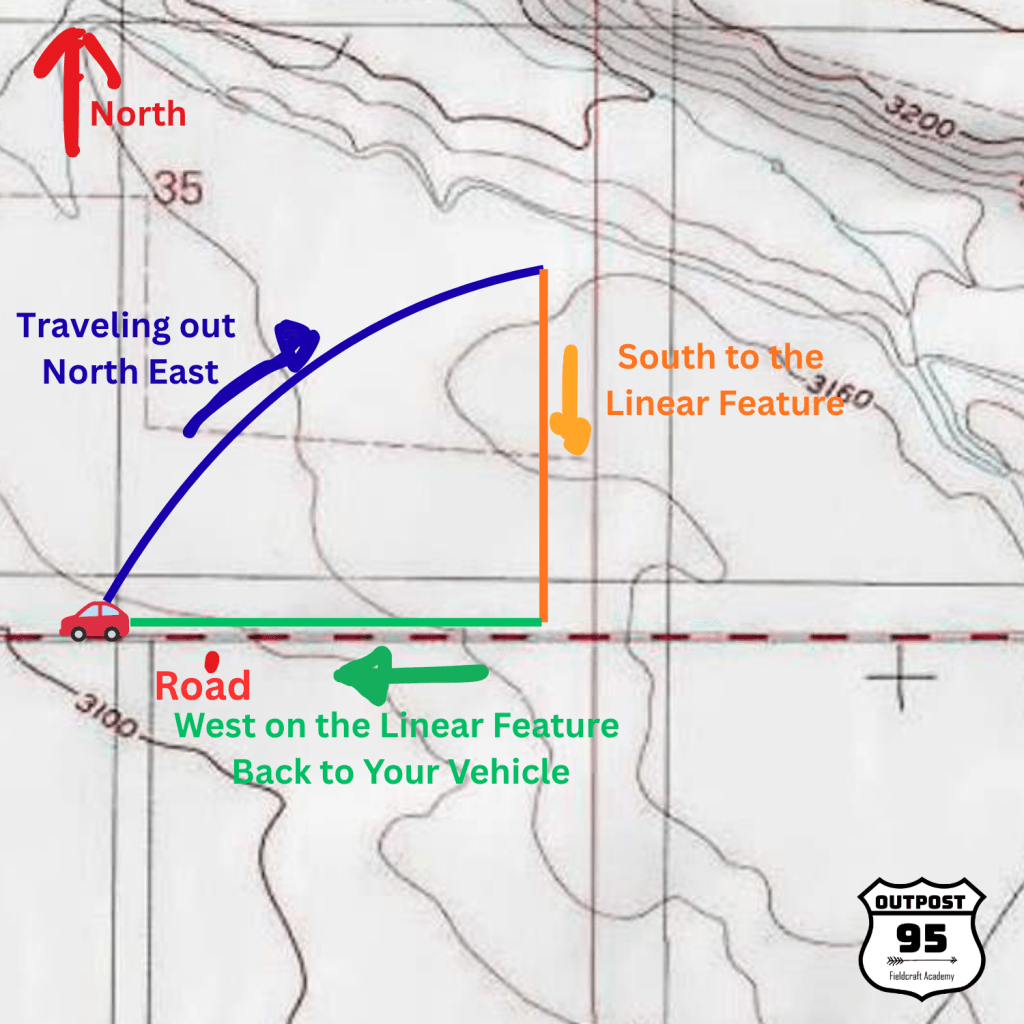
He had a concern it seems many others also do. So I shared with him the best way I know of to remain found. If you start on a linear feature and head away from it, note the direction you are travelling on your compass. For example: I parked on an east-west road and begin walking north, then if I walk south I will arrive back at the road.
To take it one step farther, and to know which way to go once I arrive back at the road I add one step. Instead of walking at a perpendicular angle to the linear feature (north in the previous example), I instead travel north as before and favoring one direction (east or west, east for this example). So I am traveling in a general northeast direction. Now it is time to head back to my vehicle. I return to road as before (south in our example). Once I reach the road, I go the opposite direction that I favored traveling away from my vehicle, (so I turn west on the road and take it back to my vehicle).
As long as you can generally keep yourself walking in a direction, you simply reverse the order to go back. This isn’t precise navigation but its not meant to be either. It allows you to hike, explore, hunt, or whatever you’re doing without needing to consult a map and only briefly checking a compass. You will likely use time as your measurement, meaning I walked for two hours. So I should arrive back around two hours or a little more.
So what is a linear feature? An obvious natural or man-made item with a distinct border that extends for distances best measured in kilometers or miles. Examples would include: roads, railroad tracks, power lines, trails, rivers, large lake shores, the base of mountain ranges, large distinct ridge lines, fields where they meet tree a line, possibly fence lines, etc. The idea is to pick something you will recognize when you reach it.
For most people roads work well. This is because most people will drive to where they start walking and they want to get back to their vehicle to return home. Check your compass when you begin and periodically as you walk. If you’re not sure how well you can maintain a course, then check the compass every few minutes of walking until you are comfortable.
Another great time to use this technique is in setting up your camp. If you set it along a linear feature you will be able to find it back much easier. Take note however that this technique not advised if you find yourself in a non-permissive environment, as linear features are natural lines of drift, where people are more likely to happen by chance across your camp, but this is the topic of an upcoming article.
One trick that may help you is to make a quick sketch in a notebook as you start out, so you can reference it and help visualize the route you will be taking.
If you know that you need to navigate to not get lost, but you also know that you don’t want to go into precise map work and math, then this approach should help you, without being to overwhelming. If nothing else use it to stay found while you are developing more advanced navigation skills.
-Joe
 Outpost 95