

Nehemiah 4:11 And our adversaries said, They shall not know, neither see, till we come in the midst among them, and slay them, and cause the work to cease.
Nehemiah was called to rebuild the city of Jerusalem. The enemies around them conspired to stop the work and kill the people. Nehemiah remained faithful to God and together they worked as a community, not ignoring the danger nor being stopped by fear.
Nehemiah 4:14 And I looked, and rose up, and said unto the nobles, and to the rulers, and to the rest of the people, Be not ye afraid of them: remember the Lord, which is great and terrible, and fight for your brethren, your sons, and your daughters, your wives, and your houses.
They prepared for a real danger as a whole by remaining arm and ready.
Nehemiah 4:16-23 [16]And it came to pass from that time forth, that the half of my servants wrought in the work, and the other half of them held both the spears, the shields, and the bows, and the habergeons; and the rulers were behind all the house of Judah. [17]They which builded on the wall, and they that bare burdens, with those that laded, every one with one of his hands wrought in the work, and with the other hand held a weapon. [18]For the builders, every one had his sword girded by his side, and so builded. And he that sounded the trumpet was by me. [19]And I said unto the nobles, and to the rulers, and to the rest of the people, The work is great and large, and we are separated upon the wall, one far from another. [20]In what place therefore ye hear the sound of the trumpet, resort ye thither unto us: our God shall fight for us. [21]So we laboured in the work: and half of them held the spears from the rising of the morning till the stars appeared. [22]Likewise at the same time said I unto the people, Let every one with his servant lodge within Jerusalem, that in the night they may be a guard to us, and labour on the day. [23]So neither I, nor my brethren, nor my servants, nor the men of the guard which followed me, none of us put off our clothes, saving that every one put them off for washing.
A great many principles are at work in the 4th chapter of Nehemiah: trusting God and being faithful, working as a community, being aware of the danger and prepared for it, having g a communication plan, and not letting fear paralyze them.
Just as in the days of Nehemiah, during WWII there was real concern for many nations about being invaded. The 1930s had a worldwide build up of strife and violence, and unfortunately this pattern appears to have started again. With tensions running at all time highs between the super powers, a weakening American might, financial upheaval, and what looks like the late 1930s all over again beginning with the Ukrainian war.

The British Home Guard was designed to be a local force, able to respond to an invasion. A force which would hopefully hold the enemy at bay until the army was able to respond. They also were tasked with guarding key points of infrastructure and freeing up the active duty forces.
The Home Guard ranks were filled by members of the community whose occupation prevented them from military serve, or they were precluded from serve due to age. They were none the less concerned and motivated to provide for the protection of their communities and their nation.
The “Home Guard Handbook” published in 1940 stated that the main duties of the Home Guard were :
- “Guarding important points
- Observation and reporting – prompt and precise.
- Immediate attack against small, lightly armed parties of the enemy.
- The defense of roads, villages, factories and vital points in towns to block enemy movement.”
Every member of the Home Guard was expected to know :
- “The whole of the ground in his own district.
- The personnel of his own detachment.
- The headquarters of his detachment and where he is to report for duty in the event of an alarm.
- What the alarm signal is.
- The form of reports concerning enemy landings or approaches, what the reports should contain, and to whom they should be sent.”
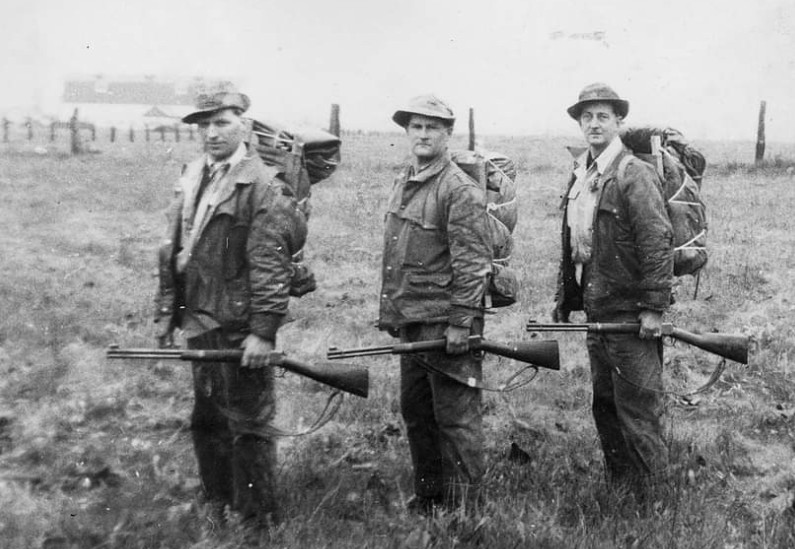
The Pacific Coast Militia Rangers (PCMR) came about after the Japanese attacked Pearl Harbor. The residents of British Colombia were concerned how far they would advance. From a planning stand point Canada didn’t have the manpower and resources to position on the Pacific as the British Colombians would have preferred. They were an unpaid volunteer force, the recruits came from the came from trappers, loggers, and fishers from not only the coastal regions but well into the interior as well.
The duties were three fold:
- Patrol their local area.
- Report suspicious activities observed.
- If necessary serve as guides to regular military units.
- If invaded, to fight as guerrillas.
These units were much different than a traditional military unit, they were a part time force designed to fully understand their home area and not deploy outside if it. They were part time and still the responsibilities of life to meet. They were sparsely equipped, having to rely on skill and resourcefulness verse equipment and technology.
The Home Guard in its original conception had an urban flair, with more manpower and support from the British government. At its beginning it was given a higher priority by those passing out resources than the Rangers received.
Whereas the Rangers had a rural flair, capitalizing on the individual self sufficient nature of its recruits. The material support was limited to a helmet and armband, and eventually a rifle and ammunition. They would be considered scouts, rangers, or light infantry. They never likely to get support in a fashion a line infantry soldier or Marine would be accustom to. For example, when I was in Iraq with 7th Marines the longest we had to wait for help was no more than a couple of hours. The PCMR were unlikely to receive much or any assistance outside of themselves and possibly the community.
Because of these factors, the Rangers seem like a more practical model to follow for the area I live in. And we will be explore training in this light.
I’m aware I picked a couple of examples from the United Kingdom, but they are worth studying on how to keep our communities safe. Especially in an unsupported/limited supported mode, should the paradigm shifts and the established public service systems/military system gets overwhelmed or broken. It’s not trying to take those functions over, or attempting to be an all consuming part of the community’s life. It also is something that need to to be established before an issue arises as people rarely rise to the occasion, instead falling to the lowest level of their training.
In a modern example of the Home Guard concept, YouTube and nontraditional media was full of stories prior to the Russian invasion into Ukraine of the Ukrainian people training and preparing to defend their communities. A few months training was certainly better than nothing. Their panic was definitely noticeable and rightfully so as they were behind on their preparations.
If we study the actions of military planners we can see the Marine Corps has restructured some of its units in the Pacific into the Marine Littoral Combat Team. A move designed to counter any nation states set on dominating the pacific in a similar manner to what we saw Japan do during WWII. The concept seems timely and practical.
How does this relate to us at the Outpost? In Ukraine we saw the panic from the urgency of the pending invasion. In the Pacific the Marine Corps in preparing for an invasion from the east. Unless some major changes happen nationally and on the world stage we have entered another Cold War and this one has the potential to become another world war. The concept of small teams from the local area, working together to monitor an area, report to the local authorities, and have the capability to be a force to be reckoned with in the worst case scenario has been historically valid. It would be an interesting study and a way of defining places to focus your fieldcraft training.
I for one don’t want to fight in another war, but having been apart of an invading army I don’t want my family living under that even more. Following the advice in Nehemiah seems best: remaining faithful to God, being prepared as a community, and not succumbing to fear.
-Joe
Sources:
 Outpost 95