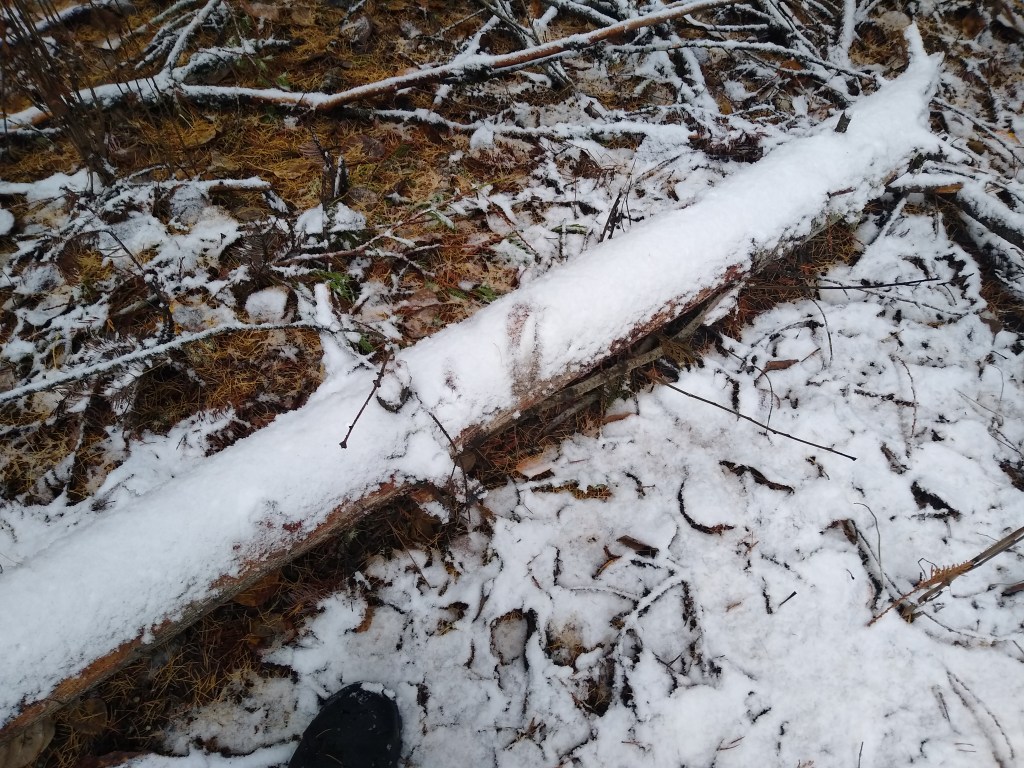
Why consider tracking? It is mostly a dying art, kept alive in a few circles. Military scouts, African anti-poaching teams and hunters, the Border Patrol, search and rescue teams, and die-hard hunters and trappers are keeping the art alive.
Does it still have an application for others? Of course it does, although I have a bias because I enjoy it. Several times a week I walk the perimeter of my property and look for evidence of animals or people moving through. This helps me to keep coyotes, raccoons, and neighbor’s dogs from getting into my animals and shows me where I need to have game cameras at if I want current pictures of deer, elk, and moose. If I had people moving through without permission, then I would have a heads up if it is to begin occurring.
Tracking helps me to scout for the hunting and trapping seasons, and just as importantly I get to assess how much pressure the area is receiving from other hunters and trappers in the area. The experience has me more aware of my surroundings and made my hunting more enjoyable in general.
Tracking is often portrayed as the means for finding the subject of your quarry, which would be pursuit tracking. It also has as much application for finding out what occured at a place, or what is happening on a consistent basis, which would be scout tracking. Scout tracking is an underrated skill, but it is important as it will tell you much information about the habits of the animals and people in the area.
When we look at Major Roberts Roger’s “Rules for Ranging” we find several rules highlighting the importance of tracking:
- If we strike swamps, or soft ground, we spread out abreast, so its hard to track us.
- When we march, we keep moving till dark, so as to give the enemy the least possible chance at us.
- Don’t ever march home the same way. Take a different route so you won’t be ambushed.
- If somebody’s trailing you, make a circle, come back onto your own tracks, and ambush the folks that aim to ambush you.
Now a couple of Roger’s rules don’t directly say tracking, but it seems to me the enemy force he was concerned about was locating and following him by utilizing tracking to further their efforts.
When General Mattis wanted his Marines to further improve their capabilities and ordered the creation of the Combat Hunter Program. This program focused on three distinct areas: observation, tracking, and combat profiling. All three are in the fieldcraft realm and the heart of the information I am attempting to share through these classes and blogs. This Combat Hunter Program shows the importance of tracking remains as true for our troops today as it did during the French-Indian War some 250 years ago.
There are negatives to tracking, mostly it is a time consuming activity to learn, and to maintain. It also requires access to training areas. The good news is it doesn’t really require specialized equipment so there is no financial penalty to give it a try. Quiet cloths, binoculars, and water bottle will cover most of your bases, and they aren’t must haves when you first begin.
David was pursed for a great deal of time and much is written about him in the Old Testament, in Psalm 140:5 The proud have hidden a snare for me, and cords; They have spread a net by the wayside; They have set traps for me. David was praying to God for deliverance, and it is the blessing of the same skill then as the Marines of today use to notice an IED.
Tracking has a surprising number of applications for you whether you are homesteader, hunter, trapper, soldier, or someone desiring more awareness of the activities in your environment. And ultimately tracking is a whole lot of fun, you should give it a try!
-Joe
 Outpost 95
We want to learn! That sounds awesome!
LikeLike